Skip to product information
1 of 5

Prisoner of Their Words

Prisoner of Their Words

A Practical Guide to Breaking Free from Reassurance Addiction

Regular price €35,95 EUR
Regular price Sale price €35,95 EUR
Sale Sold out

(Less than one therapy session)

Why readers trust this guide

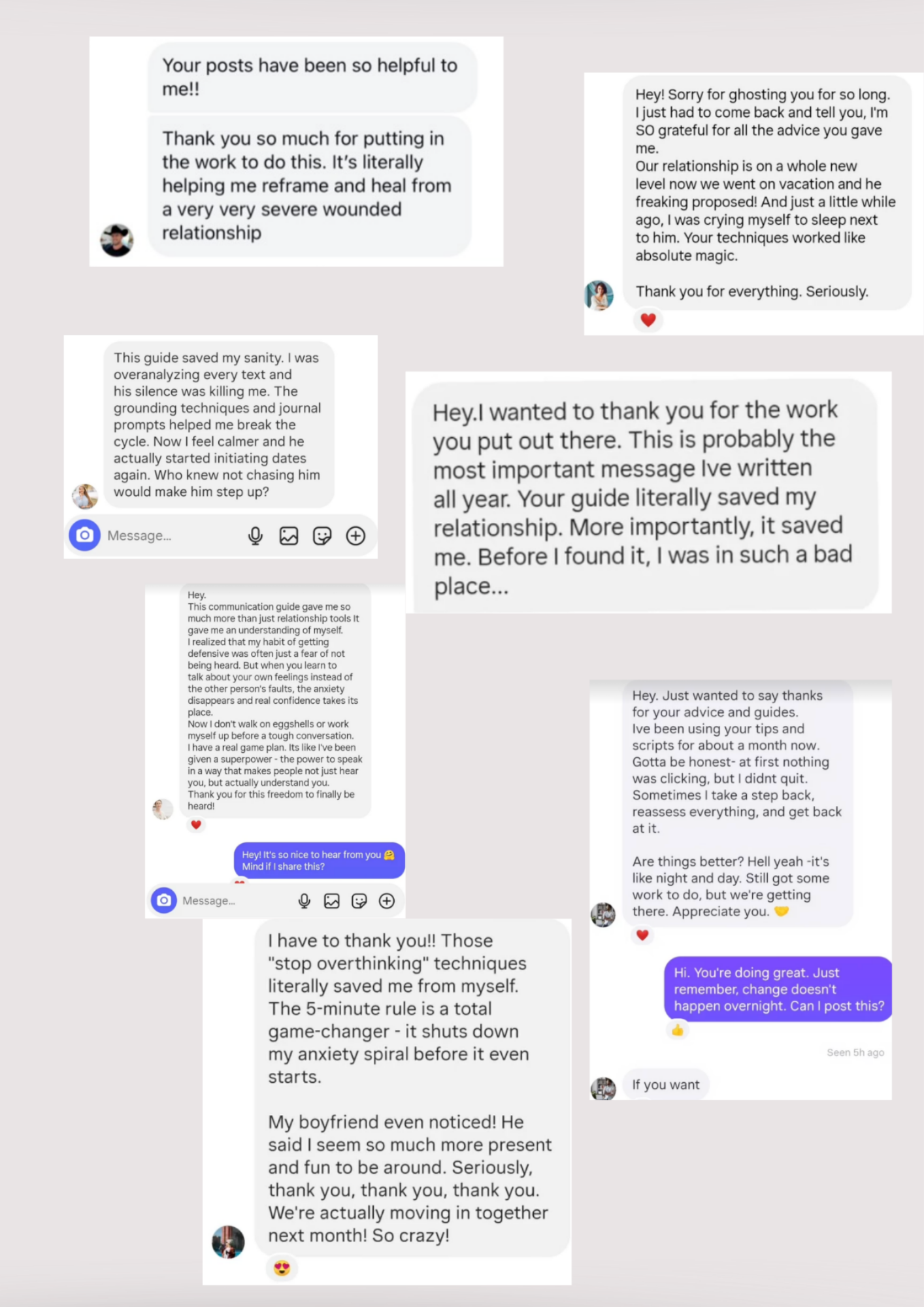
Over 2000 readers have completed the 14-day protocol

Not because it promises quick relief, but because it explains patterns many readers have lived with for years without language.

Readers often mention feeling recognized rather than corrected, and understanding their nervous system without being pushed to “fix” themselves.

Instant digital access

Purchase → Instant PDF download → Use tools today

14-Day Money-Back Guarantee

Use the protocol for 14 days. If you don't see reduced reassurance urges, email us. Full refund, no questions.

Break the Reassurance Cycle in 14 Days

You asked 'do you still love me?' and the answer stopped being enough 10 minutes later.

This is the cycle: you need to hear it, they say it, it fades in minutes, the panic comes back, you ask again. You know it's not rational. You know they already answered. But your brain won't let it go. That's not a character flaw. That's a pattern, and patterns can be broken.

This isn't about willpower or 'just stop overthinking.' It's a 14-day protocol built on the science of why your brain does this and how to rewire it.

What you get:

✔️14-day structured protocol to interrupt the reassurance pattern
✔️ Somatic tools for when your body screams "ASK NOW"
✔️ Science explained simply (no jargon)
✔️ A real solution when willpower alone isn't enough

View full details

This guide is for you if...

Every time you ask for reassurance, you're teaching your brain you can't survive without it, and teaching them you'll never be satisfied.

  • The 10 Minute Reassurance Half-Life

    You ask "do you still love me?" and feel relief, for exactly 10 minutes. Then the warmth evaporates. The compliment they gave you at breakfast feels like it never happened by lunch. You need fresh proof, again and again, because your brain won't believe the reassurance, no matter how genuine it was

  • The Self-Abandonment Cost

    You've cancelled plans with friends in case they text back. You can't focus at work because you're waiting for their reply. You've lost track of your hobbies, your goals, your sense of self, because your entire nervous system is calibrated to one thing: monitoring whether they still love you. You're not living your life. You're waiting for permission to feel safe.

  • The Biological Panic Response

    When they don't respond immediately, your chest tightens. Your heart races. Your thoughts spiral into catastrophe: "They're done with me." This isn't overthinking. Your amygdala processes their silence as a physical threat. Your body floods with cortisol as if you're in danger, because to your nervous system, losing their reassurance feels like you're losing oxygen.

  • The Phone Prison

    You check their last seen. You reread their messages looking for tone shifts. You can't put your phone down because every minute of silence feels like proof that something is wrong

  • The Apology Reflex

    You say sorry for everything. For crying. For asking. For existing too loudly. You apologize before they even react, because somewhere you learned that taking up space means losing love

  • The Tolerance Trap

    You used to need it once a week. Then daily. Then multiple times a day. Like any addiction, your brain built tolerance, each dose of "I love you" works less and less. You need bigger hits, more frequent confirmations, until nothing they say holds for more than an hour. And they can't keep up.

  • ⭐⭐⭐⭐⭐ Sarah M. 29

    I stopped asking 'do you still love me?' by day 9. My partner actually noticed and said I seem calmer. The somatic tools in Part 3 saved me when the panic hit, I didn’t think anything could replace their words, but my own breathing did

  • ⭐⭐⭐⭐⭐ Lucas L. 32

    Finally, a book that doesn't gaslight me with 'just trust them more.' Day 4's exercise on the biological panic response made me cry, someone finally explained why 2 minutes of silence feels like 2 hours. I'm not broken, I'm wired differently

  • ⭐⭐⭐⭐⭐ Emma R. 27

    I went from checking 'last seen' 30+ times a day to… maybe twice. It wasn't fast, I had to repeat Days 6–8 twice, but the anchor technique actually works. My friends say I'm 'back' and keep asking what changed

  • ⭐⭐⭐⭐⭐ Daisy W. 24

    I'm on Day 11 and still have urges, but now I pause instead of texting. The '10‑minute half‑life' section hit me hard, no wonder reassurance never stuck. This isn't a cure, but it's the first thing that's given me actual tools, not just 'work on self‑esteem'

FAQ

Is this science-backed or just "pop psychology"?

This guide is grounded in attachment theory, polyvagal theory, and neuroscience research on anxiety patterns. You'll find clear explanations of how your nervous system creates reassurance urges, without academic jargon. The techniques combine evidence-based somatic practices with cognitive reframing that's been tested with real people, not just theory.

Will I get practical tools I can use immediately?

Yes. Day 1 starts with actionable exercises you can use the moment panic hits. You'll learn the 5-minute pause technique, somatic anchoring for when your chest tightens, and how to identify your specific reassurance triggers within the first 48 hours. This isn't a philosophy book, It's a daily action plan.

Do I need to do this with my partner, or can I do it alone?

This is YOUR work, done independently. You don't need to tell your partner, involve them in exercises, or explain what you're doing. The changes happen inside you, they'll just notice you seem calmer and ask less. Your healing doesn't require their participation.

Is this really a personality flaw?

No. Reassurance addiction is a nervous system pattern, not a character defect. Your brain learned this response to feel safe, usually from early attachment experiences. This guide helps you understand the biology behind your urges without shame, so you can rewire the pattern instead of fighting yourself.

Will this help if my partner avoids intimacy?

This book focuses on YOUR relationship with reassurance, not changing your partner. That said, when you stop seeking constant validation, it often shifts relationship dynamics naturally. Many readers report their avoidant partners actually moved closer once the pressure lifted. You don't need their participation to break free.

Can I read the E-book on my Kindle or iPad?

Yes! You'll receive a PDF that works on any device, Kindle, iPad, phone, computer, or you can print it. The format is optimized for easy reading and includes fillable exercises if you prefer digital journaling. Access it anywhere, anytime.

What if my anxiety is too severe for a self-help book?

If you're experiencing panic attacks multiple times daily, severe depression, or thoughts of self-harm, please seek professional support first, this book complements but doesn't replace clinical care. For moderate reassurance-seeking (asking multiple times daily, checking texts constantly), this protocol provides effective tools most people can implement safely.

How long does it take to complete?

The protocol is designed for 14 days, with 20-30 minutes of reading and exercises per day. Some people move through it faster, others repeat certain days. It's self-paced, there's no "failing" this. Progress over perfection.

What if I don't receive my download link?

Please check your spam or promotions folder first. If it hasn’t arrived within a few minutes, simply reach out to us via the contact page or chat. We will manually resend your link immediately to ensure you can start your journey stress-free.

What is your return policy?

Because our e-books are delivered instantly, we generally do not offer refunds once the file has been downloaded. However, we want you to feel supported. If you have any technical issues or haven't accessed the link yet, contact us within 14 days, and we’ll make it right.